BENGALURU, INDIA, 10 September 2026 — Senior leaders inside the same organisation cannot give the same account of the AI agents their company is running. Asked to score their own organisation’s readiness to run autonomous agents, their answers landed an average of 14.5 points apart on a 100-point index.
Not vendors disagreeing with customers. Colleagues, describing the same company.
The finding comes from the Agentic AI Readiness Index, the field instrument behind State of Agentic AI 2026, released at the fifth annual CyBe AI Summit in Bengaluru on 3 and 4 September. The study scored 204 senior leaders across 171 organisations on eight dimensions of agentic AI readiness. The index deliberately surfaces internal disagreement: where a CISO, an engineering lead and a business owner give materially different answers about the same agent estate, that disagreement counts as a readiness finding in its own right, because it shows the organisation holds no single shared view of what it is running.
CyBe Global conducted the study in association with the CSA Bangalore Chapter, the Bengaluru chapter of the Cloud Security Alliance and a non-profit community of more than 10,000 cybersecurity professionals. The report, State of Agentic AI 2026: Trust, Value and Control, combines eight authored pillar studies with the index field data, and publishes its full methodology and sample composition at https://cybe.global/research
"You cannot govern what your own leadership team cannot describe consistently," said Satyavathi Divadari, Founder and CEO of CyBe Global. "The disagreement is the finding."
CyBe Global unveiled three professional certification programmes at the summit, each targeting the accountability gap the data exposes: Certified AI Governance Leader (CAIGL), delivered in partnership with SRM Executive Education, Certified AI Security Officer (CAISO), and AI SOC Analyst (AISA).
Divadari, a security leader with 28 years in the field, argues that AI is rewriting the top security job as AI systems become active participants in enterprise operations.
"There is a possibility that there will be no CISO roles," Divadari told the summit. "The job is not going away. The name is. In future, it will be Chief AI Security Officer."
Her argument tracks a transformation the industry has been through before. As cybersecurity expanded beyond information systems into broader digital and enterprise risk, security leadership itself evolved. For boards, Divadari contends, the question is increasingly not only whether an organisation is secure, but whether its AI systems, autonomous agents and AI-driven decisions can be trusted.
All three programmes follow a design principle that breaks with how most security certifications operate: the learner takes on the job role from the first session and earns the credential on the work they produce.
"When you go to a job, has anybody told you, ‘This is the chapter, this is the lesson, this is how you’ll answer?’ No. There is no cookbook. You learn by doing," Divadari said.
Participants work in cloud-based labs, investigate realistic scenarios, make decisions, produce executive deliverables and defend their work.
CyBe Global builds the job roles from ongoing research with CISOs, security leaders and practitioners, examining how responsibilities are changing and what organisations expect people in those roles to deliver. Independent cybersecurity leaders then review the resulting capabilities and curriculum as advisors and programme reviewers, including 13 security leaders currently in post. The programmes map to NICE, MITRE ATT&CK, NIST, ISO/IEC 42001 and the EU AI Act.
CyBe Global introduced each certification through hands-on sessions at the summit, letting delegates work the methodology before enrolling.
Certified AI Governance Leader (CAIGL) targets professionals responsible for AI decisions that must withstand board, regulatory and organisational scrutiny. Participants act as an AI Governance Leader responding to product launches, risk decisions and regulatory requirements, and earn the credential through a portfolio of demonstrated work rather than a conventional examination. Delivered with SRM Executive Education, the programme begins with cohort-based sessions, with an extended 11-month format in development. The next international cohort runs 16 to 21 November 2026.
Certified AI Security Officer (CAISO) prepares security professionals for leadership in AI-native enterprises. Delivered over five evenings plus a Saturday immersion, it combines executive decision-making with practical AI-security scenarios, and practitioners assess every written response. The next international cohort runs 30 November to 5 December 2026.
AI SOC Analyst (AISA) addresses the changing security operations centre, covering both AI-enabled attacks and the tools defenders use to respond. Participants work with enterprise security consoles in a cloud-based environment. The next cohort begins 17 October 2026, in Bengaluru or virtually.
The three programmes sit above Cybersecurity Foundations (C0), CyBe Global’s free beginner programme.
The accountability question surfaced again on the summit floor. In a live debate on whether AI agents will make Level 1 and Level 2 SOC analyst roles obsolete by 2028, the audience at the summit was asked what a junior analyst can do that AI cannot. It did not point to speed, pattern recognition or access to data. It pointed to accountability. AI can investigate, recommend and increasingly act, but a person still owns the consequence of the decision.
That distinction ran through both keynotes at the summit. Jim Reavis, Co-founder and CEO of the Cloud Security Alliance, opened the main day with "Charting What’s Next: Cybersecurity Leadership in the AI Era," describing a near-future in which security professionals work alongside hundreds or thousands of AI agents. Dr. Shreevyas H M, Project Director at the Centre for e-Governance, Department of Personnel and Administrative Reforms, Government of Karnataka, delivered the Chief Guest keynote, sharing real-world perspectives on AI adoption and the challenges organisations face as AI moves from experimentation into implementation.
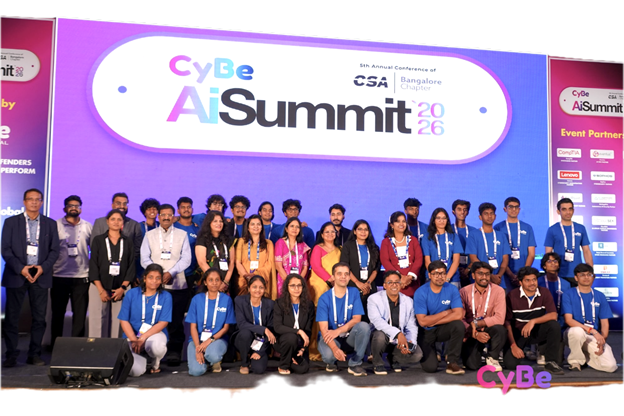
More than 800 cybersecurity and AI professionals, CXOs and speakers attended the two-day CyBe AI Summit, held in partnership with the CSA Bangalore Chapter, on 3 and 4 September.
The summit opened on 3 September with an invitation-only CXO Sub-Summit at the Sheraton Grand Whitefield, where 60 senior security and technology leaders worked through an immersive roundtable format on the current state of AI and cybersecurity. The session ran without presentations or vendor booths, and executives worked the questions directly with one another.
The main day followed at the NIMHANS Convention Centre and closed with the CyBe Cyber.AI Excellence Awards, which recognised 21 winners across seven categories.
About CyBe Global
CyBe Global is a cybersecurity and AI skills company that trains professionals for AI-era security roles. It builds practitioner-led certification programmes, cloud-based labs and applied research, and grades learners on proof of capability rather than attendance. Its role-based curriculum draws on continuous research with serving CISOs and security leaders, who also review it. Satyavathi Divadari and Pooja Agrawalla founded the company in January 2026, and both lead the CSA Bangalore Chapter, as Chairperson and Co-Chair. CyBe Global works with organisations, professionals and academic institutions in India and internationally. More at https://cybe.global